Posts

Measuring your Knowledge Management Framework Success using NPS

  As Drucker says – “If you can’t measure it, you can’t manage it”. In the highly competitive market landscape, knowledge management (KM) has now been well established as a requisite to innovation. The knowledge that is streamlined, relevant, and readily available round the clock fosters productivity, efficiency, and innovation to help organizations improve their competitive edge. Nevertheless, the Knowledge Management system and capabilities need to be constantly revised and improved in order to be aligned with business goals and assist the organization. Net Promoter Score (NPS) is one of the most effective tools for gathering feedback and measuring the effectiveness of your Knowledge Management system. A high NPS score indicates a well-built KM system. NPS measures the effectiveness of your current KM framework using a 0 to 10 scale.  You only need to ask your target audience one question – “how likely are you to recommend a specific service/community to a colleague or frien...
Knowledge Decay Series Part 2: The Role of Knowledge Management in Knowledge Evolution

Capturing and retaining institutional knowledge has been emphasized enough for organizations to maintain a competitive edge and increase their profitability. One aspect that is not mentioned enough is the need to continue evaluating and evolving existing knowledge in order to keep it relevant and prevent knowledge decay. In the highly fast-paced and competitive landscape, knowledge constantly evolves. However, the fact of the matter is that it is the existing knowledge that leads to its evolution. Therefore, knowledge decay can be detrimental to an organization’s goals and profit. Let us see below how organizations can prevent knowledge decay to stay competitive, innovative, and relevant to clients: Make a cultural shift to embrace learning and sharing : Learning, knowledge sharing, and collaboration should not be limited to the L&TD and knowledge management teams. Organizations should cultivate a culture of continuous learning and knowledge sharing among their employees. A well-de...

Breaking the Knowledge Silos Barrier

Innovation is a buzzword for organizations today that are striving to be the best in the highly competitive world. How do we use the collective brains of people in an organization to innovate? The easy and the simplest answer is to break the knowledge silos that most organizations struggle with, more so with flexible and WFH culture becoming a part of the corporate world. And the fact of the matter is that Hybrid and WFH culture is here to stay so the organizations that fail to come up with ways to break these silos now should be ready to face even bigger and harder-to-solve challenges in the future in terms of knowledge loss and ability to maintain their competitive edge. So, what is knowledge silos?  It is the long prevalent culture where knowledge and information from a team member or a team stay within the team with no protocols in place to take it to the whole organization. The lack of knowledge management protocols and processes to ensure the distribution of knowledge across ...

How Knowledge Management creates Superior IT Service Management

During  the last two decades, the creation and enablement of knowledge  has been highly stressed  as a  way   to   increase   competitive advantage . There has been a paradigm shift in  the   way  intellectual knowledge is now viewed and nurtured by organizations to  remain  relevant  and competitive. By   repurposing   knowledge   and   reducing   the   need   to  rediscover   it,  Knowledge   Management   (KM)   enables people  to work better   by   enabling them  to  connect   people   and  knowledge . The  IT Service Management  Unit  is one of the most  vital  business units responsible for managing, providing, and improving  the  IT services provided to  employees,  thus  enabling them to work  efficiently   and  productively . By   integr...

Knowledge Decay Series Part 2: How Organizations can keep Knowledge Relevant

Capturing and retaining institutional knowledge has been emphasized enough for organizations to maintain a competitive edge and increase their profitability. However, one factor that is not discussed enough is the need to continuously evaluate and evolve the existing knowledge to keep it relevant and prevent knowledge decay. In the highly fast-paced and competitive landscape, knowledge constantly evolves. However, the fact of the matter is that it is the existing knowledge that leads to its evolution. Therefore, knowledge decay can be detrimental to the organization’s goals and profit. Let us see below how organizations can prevent knowledge decay to stay competitive, innovative, and relevant to the clients: Make a cultural shift to embrace learning and sharing : Learning, knowledge sharing, and collaboration should not be limited to the L&TD, and knowledge management teams. The organization should inculcate in the employees a culture of continuous learning and sharing knowle...

How Institutional Knowledge Decay Impacts an Organization’s Growth.

  In the information age, knowledge is power. Knowledge is constantly evolving, and we are being bombarded with new knowledge every day. What was a fact few years ago is now considered outdated or irrelevant. The decay of knowledge not only affects us an individual but is also affecting the organizations. Technologies change constantly leading to decay of knowledge. Companies need to keep up with the market trends and constantly innovate to stay relevant and competitive. Organizations generally go through a rigorous process for hiring the rights skills and experience. Also, the workforce is trained in specific skills and tools to align with their role and organization’s goals. But the fact of the matter is that employees leave and take along with them crucial knowledge and experience.    Also, people retire, taking their wealth of experience and insights which is then lost to the organization where an employee gained it all. Organizations are then left struggling to fil...

Enforcing Knowledge Management in Law Enforcement Agencies

  The world is interconnected and rightly called global village. The interconnectedness brings out a lot of advantages in terms of culture, communication, and economy. However, this closely interconnected system also has some pitfalls. Certain people or groups like terrorists, criminals find it easy to stay under radar, travel across nations and action their nefarious activities. Because of difficulty in detecting their actions or intentions beforehand, it sometimes becomes difficult to prevent their actions and their consequences. Knowledge symmetry or seamless flow of knowledge between various law enforcement agencies globally is the only way to provide optimal law enforcement. The work of law enforcement officers is intensive, and they need a large amount of knowledge to perform their duties efficiently. This implies that effective knowledge sharing is a critical factor in policing success. A well knowledge management (KM) system can easily connect law enforcement agencies t...

How Ideation leads to Innovation

Albert Einstein, once said,  "If at first the idea is not absurd, then there is no hope for it." Ideation is the process where individuals come together in different settings like brainstorming and brainwriting sessions to generate and develop ideas and solutions to specific business challenges or goals. The core purpose of these sessions is to generate a large quantity of ideas that can be later filtered down and zeroed down to most innovative and relevant ones. During ideation sessions, no ideas are considered bad ideas. The aim is to encourage everyone to contribute with their novel ideas without the fear of criticism and rejection. Focus during these sessions is gather as many ideas as possible – technical feasible or not. They are later filtered for relevancy and how they can mesh to create value and impact.   Let us see below how to conduct these sessions to p rovide enhanced value to organizations, build competitive edge, and foster innovation. Setting up Ideation ...

Setting up a successful Knowledge Management framework.

Image
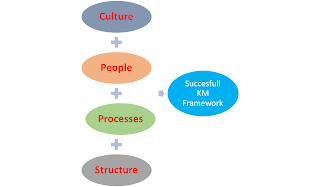
  For a knowledge management (KM) framework to succeed, it needs to be closely aligned with the business goals and embedded in the organizational culture. The four different areas that need to be considered while designing an organizational KM framework are: Organizational Culture: To achieve long term success KM needs to be embedded in the organization culture and core values. The organization needs to establish work processes that encourage knowledge sharing, and free flow & exchange of ideas.  The organization needs to value continuous learning as well as effectively retain its knowledge and repurpose it to see meaningful impact of KM in the long run. People: People are the most important asset of any organization. For a KM framework to succeed in an organization, it is vital for people to embrace and use the KM tools. When recognized as an important strategic initiative by the top management, it is more likely to be easily embraced and adapted by employees. Proce...

How is Knowledge Management revolutionizing the Health Care Industry

The healthcare industry is a knowledge-driven industry and depends heavily on the availability of updated training, health services, innovative and clinical knowledge to solve problems and provide the best possible healthcare, innovate, and achieve excellence in the field. A well-defined Knowledge Management (KM) framework is critical for healthcare organizations to achieve this goal. Knowledge Management is all about connecting people to people and knowledge enabling them to achieve strategic objectives such as innovation, competitive edge, continuous learning, and improvement. Let’s see below why the KM framework is vital for healthcare organizations. Empower decision making capabilities:  In the digital age, everyone is constantly bombarded with new information. Healthcare professionals need to make informed choices all the time to make critical decisions that might be lifesaving. However, they might feel handicapped if the information is not streamlined and accessible on the g...

Exit Interviews done right: Knowledge Onboarding from the Outgoing Employees.

When an employee exits an organization, he or she takes along wealth of experience, insights, learnings, and knowledge. If this knowledge is not captured and passed forward to other peers before the employees exit, it implies a huge loss for the organization – not only from the perspective of loss of employee but also the wealth of knowledge the employee carried with the job experience. Traditionally exit interview was considered a discussion between HR and the employee leaving to understand their reasons for quitting. However, now they have evolved and considered as a critical learning process to capture the knowledge and insights from the outgoing employee and making the learning curve short for the successor.  The exit process should make sure that the wealth of experience and competencies employee has should be accessible to the organization even after the employee is gone. This experience comes both as tacit knowledge in the form of best practices, insights, tips and tricks...

The impact of collaboration on Individuals, Teams Organizations.

Image
  Collaboration is the buzzword and rightly so. Collaboration helps organizations break down silos and enable multiple skills from global teams to come together, empowering them to innovate. The end result for organizations is better sales and delivery, increased margins, increased client satisfaction, greater client loyalty,  and competitive edge.  

Is your Knowledge Management Strategy working?

  The KM framework is constantly evolving in the past decades. The importance of managing and leveraging organization’s intellectual knowledge capital to gain competitive advantage has been stressed enough. With the ever-changing business goals, KM is now seen more and more as an integrated mechanism to bring together functional silos rather than an independent operation to manage intellectual knowledge.   Even though the KM framework varies from organization to organization based on the business structure, goals and operations, the evolution of communities, personalization approach with stress on collaborative culture, informal meet ups are some of the trends seen across organizations with end goal to create an environment that is cohesive to knowledge sharing and capturing. However, for KM to succeed and to grow and align with the changing organizational trends and business needs, comes the need to evaluate its performance and measure its success against the defined goals....

Using Design Thinking for creating scalable Knowledge Management solutions

Innovation is at the heart of any organization. All organizations strive towards: creating products and services for improved customer experiences. overcoming complex business problems using innovative processes and business models for increased impact and revenue. In this era of digital disruptions and uncertainties, innovation is the key to create a competitive advantage and “design-thinking” is one of the most innovative tools to achieve Innovation and streamline organization knowledge. So how does design thinking aligns with knowledge management (KM)? Knowledge Management help organizations retain their experiences and knowledge to innovate, improve efficiency and productivity. However, many a times true KM transformation remains a struggle for many organizations when it is not seamlessly integrated with employees needs and challenges.   KM framework cannot be a success if it is too technology driven, people find it as an extra task, and they do not want to change esp...

Cloud is Trending and How

  In the global marketplace, digital technology trends are changing the way we work. Disruptive technologies like the Internet of Things (IoT), Artificial Intelligence (AI) and Virtual Reality (VR) are changing the way businesses operate. Businesses need to be agile today to keep up with the rapidly changing industry trends, or they risk being left behind. Cloud services power the new pattern of Digital Transformation. Cloud services enable companies to continuously transform not only technologically but also culturally. From lead tracing to home delivery, no industry has been left behind by cloud services. The last decade has seen a rapid shift from traditional infrastructure to cloud infrastructure and services. Netflix is one example of a company that has moved to the cloud, redefining the way people consume TV. With the cloud ecosystem, companies can become more agile and innovative, resulting in compelling customer experiences. To remain competitive, organizations taking the j...

Folksonomy for Knowledge Management 2.0

One of the biggest challenges faced by most organizations is organizing, finding, and marking information in the knowledge repository in such a way that it is easily accessible as and when needed by the employees. The classical approach used widely is indexing documents to help users in deciding documents relevancy and retrieval.  Classical methods comprise classification systems (taxonomies), thesaurus, and controlled keywords (nomenclatures) [Aitchison et al. 2004; Cleveland and Cleveland 2001; Lancaster 2003; Stock and Stock 2008]. Folksonomy is a most recent knowledge management (km) tool of web 2.0 for searching, accessing, and labelling information by the content creator and the user in a way that makes sense to them. Folksonomies include novel social dimensions of tagging [Mathes 2004; Smith 2004]. It is a new model for content indexing based on collaborative tagging with user generated keywords that broaden the spectrum of knowledge interpretation methods. Folksonomy is a...