Posts

Showing posts with the label Knowledge Management

How Institutional Knowledge Decay Impacts an Organization’s Growth.

  In the information age, knowledge is power. Knowledge is constantly evolving, and we are being bombarded with new knowledge every day. What was a fact few years ago is now considered outdated or irrelevant. The decay of knowledge not only affects us an individual but is also affecting the organizations. Technologies change constantly leading to decay of knowledge. Companies need to keep up with the market trends and constantly innovate to stay relevant and competitive. Organizations generally go through a rigorous process for hiring the rights skills and experience. Also, the workforce is trained in specific skills and tools to align with their role and organization’s goals. But the fact of the matter is that employees leave and take along with them crucial knowledge and experience.    Also, people retire, taking their wealth of experience and insights which is then lost to the organization where an employee gained it all. Organizations are then left struggling to fil...
Enforcing Knowledge Management in Law Enforcement Agencies

  The world is interconnected and rightly called global village. The interconnectedness brings out a lot of advantages in terms of culture, communication, and economy. However, this closely interconnected system also has some pitfalls. Certain people or groups like terrorists, criminals find it easy to stay under radar, travel across nations and action their nefarious activities. Because of difficulty in detecting their actions or intentions beforehand, it sometimes becomes difficult to prevent their actions and their consequences. Knowledge symmetry or seamless flow of knowledge between various law enforcement agencies globally is the only way to provide optimal law enforcement. The work of law enforcement officers is intensive, and they need a large amount of knowledge to perform their duties efficiently. This implies that effective knowledge sharing is a critical factor in policing success. A well knowledge management (KM) system can easily connect law enforcement agencies t...

How Ideation leads to Innovation

Albert Einstein, once said,  "If at first the idea is not absurd, then there is no hope for it." Ideation is the process where individuals come together in different settings like brainstorming and brainwriting sessions to generate and develop ideas and solutions to specific business challenges or goals. The core purpose of these sessions is to generate a large quantity of ideas that can be later filtered down and zeroed down to most innovative and relevant ones. During ideation sessions, no ideas are considered bad ideas. The aim is to encourage everyone to contribute with their novel ideas without the fear of criticism and rejection. Focus during these sessions is gather as many ideas as possible – technical feasible or not. They are later filtered for relevancy and how they can mesh to create value and impact.   Let us see below how to conduct these sessions to p rovide enhanced value to organizations, build competitive edge, and foster innovation. Setting up Ideation ...

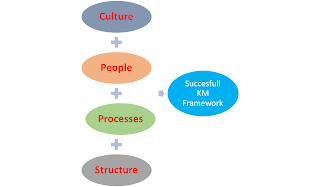
Setting up a successful Knowledge Management framework.

Image
  For a knowledge management (KM) framework to succeed, it needs to be closely aligned with the business goals and embedded in the organizational culture. The four different areas that need to be considered while designing an organizational KM framework are: Organizational Culture: To achieve long term success KM needs to be embedded in the organization culture and core values. The organization needs to establish work processes that encourage knowledge sharing, and free flow & exchange of ideas.  The organization needs to value continuous learning as well as effectively retain its knowledge and repurpose it to see meaningful impact of KM in the long run. People: People are the most important asset of any organization. For a KM framework to succeed in an organization, it is vital for people to embrace and use the KM tools. When recognized as an important strategic initiative by the top management, it is more likely to be easily embraced and adapted by employees. Proce...

How is Knowledge Management revolutionizing the Health Care Industry

The healthcare industry is a knowledge-driven industry and depends heavily on the availability of updated training, health services, innovative and clinical knowledge to solve problems and provide the best possible healthcare, innovate, and achieve excellence in the field. A well-defined Knowledge Management (KM) framework is critical for healthcare organizations to achieve this goal. Knowledge Management is all about connecting people to people and knowledge enabling them to achieve strategic objectives such as innovation, competitive edge, continuous learning, and improvement. Let’s see below why the KM framework is vital for healthcare organizations. Empower decision making capabilities:  In the digital age, everyone is constantly bombarded with new information. Healthcare professionals need to make informed choices all the time to make critical decisions that might be lifesaving. However, they might feel handicapped if the information is not streamlined and accessible on the g...

The impact of collaboration on Individuals, Teams Organizations.

Image
  Collaboration is the buzzword and rightly so. Collaboration helps organizations break down silos and enable multiple skills from global teams to come together, empowering them to innovate. The end result for organizations is better sales and delivery, increased margins, increased client satisfaction, greater client loyalty,  and competitive edge.  

Is your Knowledge Management Strategy working?

  The KM framework is constantly evolving in the past decades. The importance of managing and leveraging organization’s intellectual knowledge capital to gain competitive advantage has been stressed enough. With the ever-changing business goals, KM is now seen more and more as an integrated mechanism to bring together functional silos rather than an independent operation to manage intellectual knowledge.   Even though the KM framework varies from organization to organization based on the business structure, goals and operations, the evolution of communities, personalization approach with stress on collaborative culture, informal meet ups are some of the trends seen across organizations with end goal to create an environment that is cohesive to knowledge sharing and capturing. However, for KM to succeed and to grow and align with the changing organizational trends and business needs, comes the need to evaluate its performance and measure its success against the defined goals....

Unlocking Tacit Knowledge in Knowledge Management

  In the last two decades decade, the creation and enablement of knowledge as a source for an organization’s competitive advantage has been highly emphasized.   There has been a paradigm shift in how the organization's knowledge is now viewed and nurtured. Knowledge Management is all about knowledge creation and the activities that support the creation and dissemination at various organizational levels. It starts from instilling a knowledge vision, building a collaborative culture, facilitating conversations, globalizing local knowledge, and encouraging creativity and innovation. The integration of the above processes leading to the generation of new sources of knowledge is the key to the success of any organization. Knowledge can be both explicit and tacit. The knowledge that can be quantified and documented is explicit knowledge. It is tangible and can be conveyed through processes, documentation, books, videos, etc. However, this just forms only a fraction of any organi...

Commandments for Driving a Sustainable Community

  An organization’s collected knowledge is its most essential asset. The development of this intellectual knowledge from tacit to explicit, sharing and utilization forms the basis of knowledge management. Its purpose is to ensure that the relevant knowledge in people’s heads and the hard drive is captured and made available to the whole organization for the realization of an organization’s goals. Communities of Practice (CoP) are fundamental to the knowledge management (KM) framework in any organization. Their purpose is to provide to the members, the flow of information, access to global peers, and a platform for collaboration, innovation, and reusing of ideas leading to improved business performance and delivery. Communities are a platform for a wide variety of knowledge activities, including gathering and disseminating content, brainstorming, asking for help, solving problems, finding experts, keeping members informed of emerging trends, learning, and transferring knowledge. Bri...

Capturing Knowledge for Organizational Development

  The effective knowledge harvesting, utilization, and sharing are pivotal to competitive advantage for any organization. As Sir Francis Bacon quoted “knowledge is power”. The channeled knowledge through the Knowledge Management (KM) system helps bridge the skills gap, allowing people to make better decisions and provide efficient and productive results, ultimately leading to time and costs savings.     Knowledge can be broadly divided into two categories: explicit and tacit.   explicit knowledge can be easily codified and retained by the organization via manuals, documents, eLearning courses, etc. However, tacit or intangible knowledge that comes with people’s experiences and expertise can only be retained and channelized as explicit knowledge via the network of KM communities. This knowledge leads to better decisions and outcomes benefitting not only the people but the organization as a whole. Below given are some of the most effective knowledge management prac...